

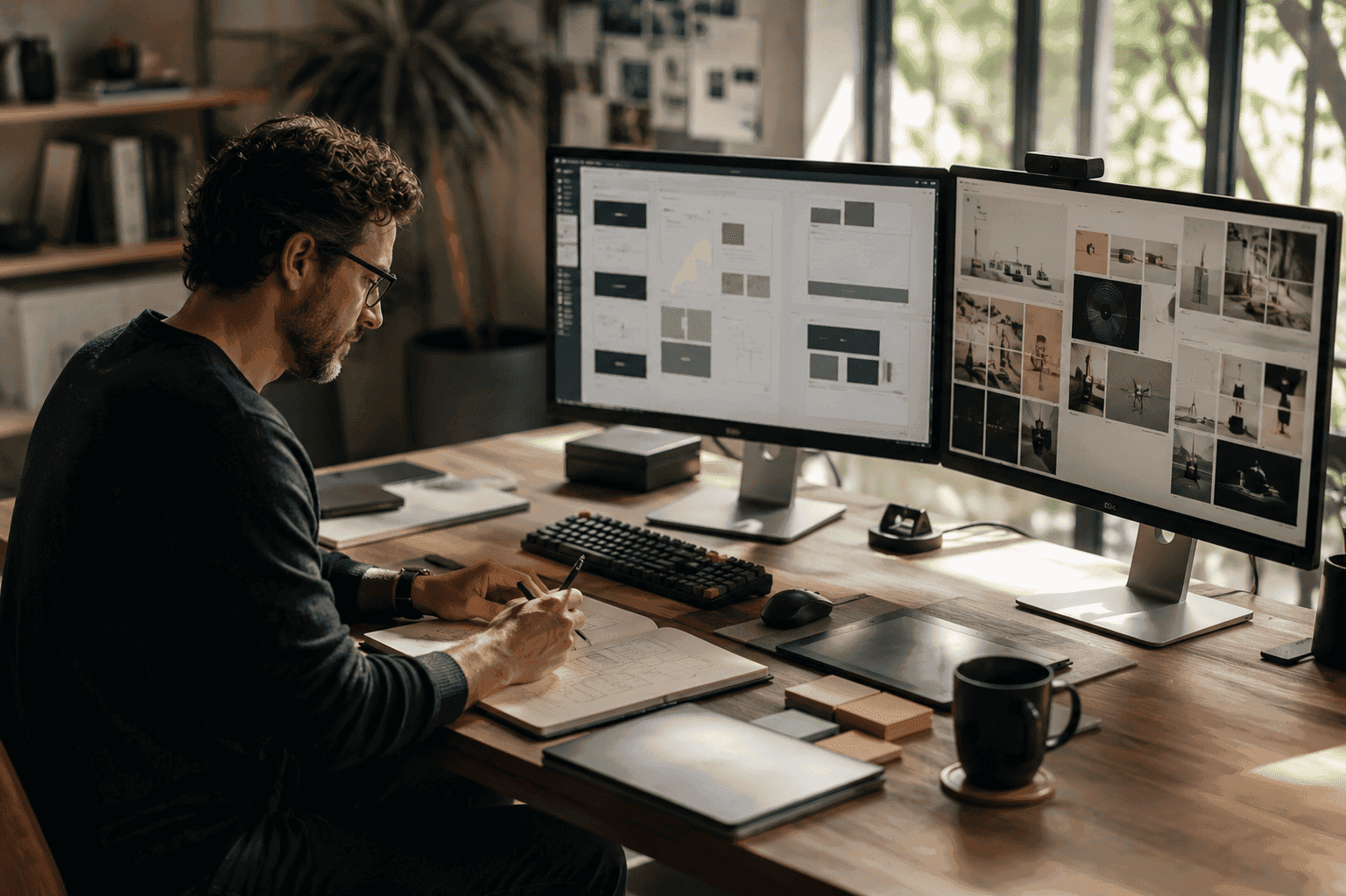
Artificial Intelligence has transformed the way designers work. Tasks that once took hours—such as creating wireframes, generating illustrations, writing UX copy, or exploring visual concepts—can now be completed in minutes. As AI tools become increasingly powerful, many people wonder if designers will eventually be replaced.
The reality is quite different.
AI isn't replacing great designers. It's changing what great designers spend their time doing.
The future belongs to designers who know how to combine creativity, strategic thinking, empathy, and AI-powered efficiency. Instead of fearing AI, designers should embrace it as a powerful creative partner.
Let's explore how AI is reshaping the design industry and why human creativity remains irreplaceable.
AI Is a Tool, Not a Replacement
Throughout history, new technology has changed creative professions.
Graphic design evolved with computers. Photography became digital. Video editing moved from expensive studios to laptops.
AI is simply the next evolution.
It automates repetitive tasks while allowing designers to focus on higher-value work such as:
Solving business problems
Understanding user behavior
Designing better experiences
Building design systems
Creating meaningful brand identities
Collaborating with stakeholders
The best designers won't compete against AI—they'll work alongside it.
What AI Does Exceptionally Well
Modern AI tools are incredibly effective at speeding up production.
Today, designers use AI to:
Generate Design Concepts
Instead of starting with a blank canvas, AI can generate dozens of layout ideas, mood boards, typography explorations, and color combinations in seconds.
This accelerates the early ideation phase without replacing creative direction.
Write UX Content
AI can quickly generate:
Button labels
Empty states
Error messages
Landing page copy
Product descriptions
FAQ sections
Designers can then refine the content to match the brand's tone and improve clarity.
Create Images and Illustrations
AI image generation tools help teams quickly visualize ideas for:
Marketing campaigns
Blog articles
Product mockups
Social media content
Concept presentations
Rather than waiting days for custom visuals, designers can rapidly prototype and iterate.
Speed Up Research
AI can summarize research documents, identify usability issues, organize interview notes, and extract common user pain points.
This allows UX teams to spend more time interpreting insights instead of sorting data.
What AI Cannot Replace
Despite its speed, AI lacks qualities that define exceptional design.
Human Empathy
Great design begins with understanding people.
Designers observe emotions, frustrations, motivations, and behaviors that AI cannot genuinely experience.
Empathy is what transforms a functional interface into an enjoyable experience.
Strategic Thinking
AI can suggest solutions.
Designers decide which solution aligns with business goals, user needs, technical constraints, and long-term vision.
That's strategy—not automation.
Brand Storytelling
Every successful brand has a unique personality.
AI can imitate visual styles but cannot create an authentic brand story rooted in a company's culture, mission, and values.
That narrative requires human insight.
Creative Judgment
AI generates possibilities.
Designers choose the best one.
Knowing what to remove, simplify, improve, or reject is where experience makes the biggest difference.
Good design isn't about creating more—it's about making better decisions.
How Professional Designers Are Using AI
Leading agencies and product teams aren't replacing designers.
They're upgrading workflows.
A modern design process might look like this:
Research customer needs.
Use AI to brainstorm ideas.
Generate mood boards and inspiration.
Create wireframes.
Design polished interfaces.
Test with real users.
Improve based on feedback.
Launch and measure results.
AI supports nearly every stage, but human expertise guides every important decision.
Skills Every Designer Should Learn in 2026
As AI becomes standard, the most valuable designers will expand beyond visual design.
Focus on developing these skills:
UX Strategy
Understanding user behavior, business goals, and product strategy creates long-term value.
Prompt Writing
Knowing how to communicate effectively with AI tools helps designers generate higher-quality outputs faster.
A well-crafted prompt can save hours of manual work.
Design Systems
Organizations increasingly rely on scalable design systems.
Designers who can build reusable components and maintain consistency are highly sought after.
Motion Design
Interactive experiences continue to grow.
Micro-interactions, animations, and motion graphics enhance usability and engagement.
Communication
Designers spend a significant portion of their time presenting ideas, explaining decisions, and collaborating with developers, marketers, and stakeholders.
Strong communication remains a competitive advantage.
Common Misconceptions About AI in Design
"AI will replace all designers."
Reality: AI replaces repetitive tasks, not creative problem-solving.
"Using AI is cheating."
Reality: AI is a productivity tool, just like Figma, Photoshop, or prototyping software.
The value comes from how you use it.
"AI creates perfect designs."
Reality: AI can generate visually appealing layouts, but they often require refinement for usability, accessibility, branding, and business goals.
Human review is essential.
Practical Ways to Integrate AI Into Your Workflow
If you're a designer looking to stay ahead, start by using AI to:
Brainstorm design concepts
Generate content drafts
Explore color palettes
Create mood boards
Produce presentation visuals
Summarize UX research
Improve documentation
Generate icon ideas
Prototype faster
Explore multiple creative directions before choosing one
The goal isn't to let AI design for you—it's to remove repetitive work so you can spend more time solving meaningful problems.
Looking Ahead
As AI continues to evolve, design will become less about creating pixels and more about creating experiences.
Businesses will increasingly value designers who combine creativity, technology, psychology, and strategy.
The designers who thrive won't necessarily be the fastest at drawing interfaces.
They'll be the ones who ask better questions, understand users deeply, and know how to leverage AI without losing the human touch.
Final Thoughts
AI is one of the biggest shifts the design industry has seen in decades—but it's also one of the greatest opportunities.
Rather than replacing designers, AI is reshaping the profession, freeing creatives from repetitive work and allowing them to focus on innovation, storytelling, and solving real-world problems.
The future of design isn't human versus AI.
It's human creativity, enhanced by AI.
The designers who embrace this partnership today will be the ones leading the industry tomorrow.
Related
Blogs
View All Blogs


Let’s Talk
